
Clay County Criminal Court Cases
Clay County criminal court cases belong to the North Carolina General Court of Justice. District Court handles original misdemeanor and infraction matters. It also conducts a felony defendant's first appearance, probable-cause work, and other early steps. Superior Court handles felony trials, felony pleas and sentencing, plus misdemeanor or infraction appeals for a new trial. Clay sits in Superior Court District 43A, District Court District 43, and Prosecutorial District 43.
The elected Clerk of Superior Court is the custodian for both trial divisions. The clerk's office is at the Clay County Government Center, 261 Courthouse Drive, Suite 1, Hayesville, NC 28904. It is open Monday through Friday, 8:00 a.m. to 5:00 p.m., and the main number is 828-389-2300. Magistrates handle initial process and release conditions at 828-389-2332, with 828-389-6354 listed as an alternate. These roles matter because a calendar, magistrate record, and complete Clay County case file answer different questions.
The Judicial Branch's Clay County court contact directory shows the clerk, judge, prosecutor, and magistrate lines. The official directory screen helps a reader reach the office tied to the exact court event.
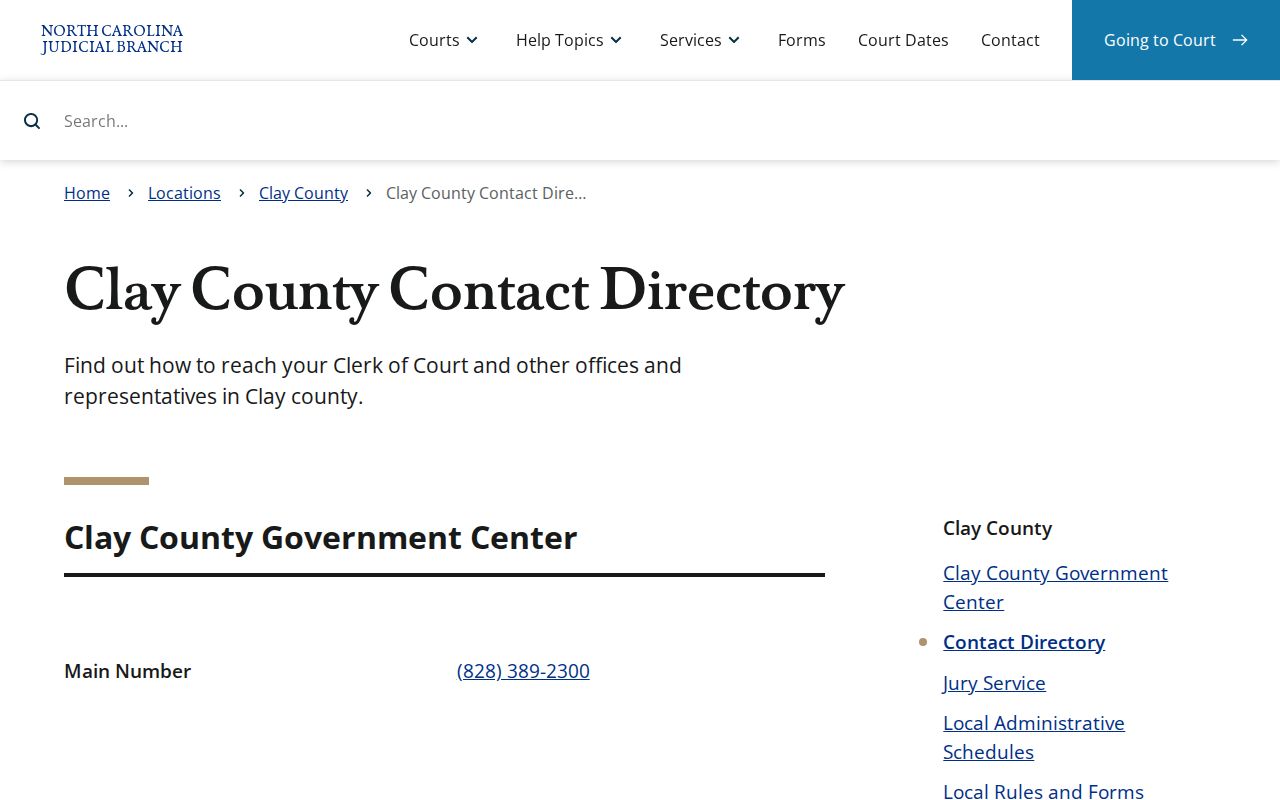
Use the clerk for the filed record, not the sheriff, when the goal is a plea, motion, judgment, or sentence.
Clay County Court Division Split
A felony can first appear in District Court before it reaches Superior Court. That does not create a town court or a separate Hayesville criminal docket. North Carolina has a unified state court system, and Hayesville has no municipal court. A citation issued in town therefore becomes a Clay County District Court matter when it is filed.
| Court or office | Clay County criminal record role |
|---|---|
| District Court | Misdemeanor and infraction trials; felony first appearances and preliminary proceedings. |
| Superior Court | Felony trials, felony pleas and sentences, and appeals from misdemeanor or infraction judgments. |
| Clerk of Superior Court | Files for both divisions, public terminal access, copies, certification, and eligible payments. |
| Magistrates | Initial judicial process and release conditions, not the complete later case file. |
A District Court misdemeanor conviction may be followed by a Superior Court trial-de-novo event if a timely appeal is taken. Read the whole event history before treating the first judgment as the final Clay County outcome.
Searching Clay County Case Records
The free North Carolina eCourts Portal is the fastest starting point for a public Clay County case search. It provides near-real-time case summaries, but Portal output is not a certified court record. Begin with broad, well-formed criteria. Add filters only when the first result set is too large.
- Open the North Carolina eCourts Portal and enter Smart Search.
- Use the exact case number when known. For a name wildcard, enter at least three last-name letters plus an asterisk and one first-name letter plus an asterisk.
- Expand Advanced Filtering after basic criteria are in place. Select Clay County as the location and Criminal Actions as the case type.
- Open the Case Summary and Register of Actions. Check charges, events, hearings, dispositions, and financial entries charge by charge.
- Use Search Hearings and NC Judgment Search as cross-checks, then ask the Clay clerk for paper documents or certified copies.
| Portal field | Type | Required | Use |
|---|---|---|---|
| Search Criteria | Text | Yes | Case number or party name, with exact or approved wildcard format. |
| Advanced Filtering | Panel | No | Works only after basic criteria have been entered. |
| Location | Dropdown | No | Select Clay County to avoid broad statewide results. |
| Case Type | Dropdown | No | Select Criminal Actions for criminal court cases. |
| Status and Filing Date | Filters | No | Narrow open or disposed cases and a known filing span. |
The official Portal training resources explain these controls and the result blocks. The captured training page shows where official help sits when a Clay County query fails.
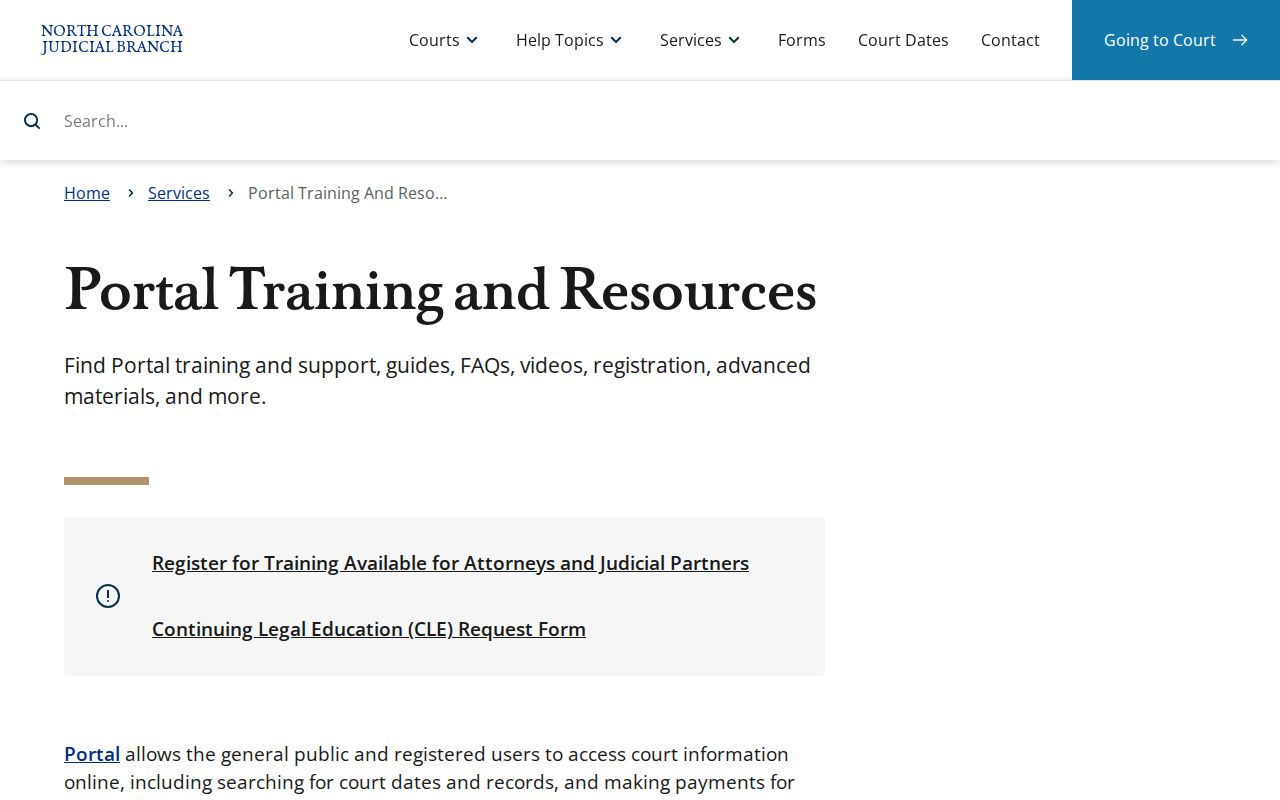
When Portal reports no match, check name and case-number format before assuming that no Clay County court record exists.
Clay Criminal Calendar Versus File
A criminal calendar tells when and where a matter is set. It does not replace the case file. Clay County's court page links live criminal calendars and local administrative schedules. A District 43A order groups Cherokee, Clay, and Graham counties, and Clay administrative sessions may fall on Wednesdays during named three-county weeks. Those schedules change by year. Confirm the current document and Search Hearings instead of relying on an old copy.
The Clay County local schedules page is the official route to current calendar material. Its screen separates scheduling aids from the docket record.
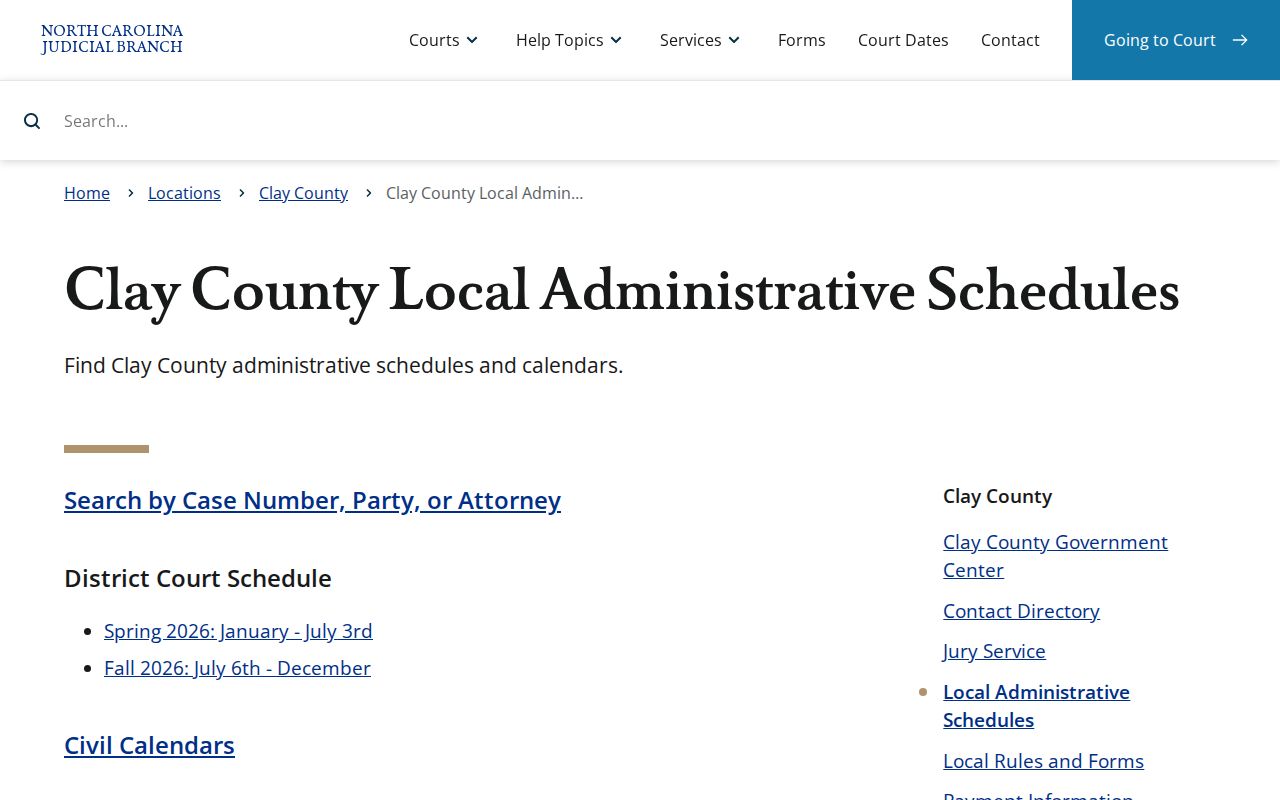
Use a calendar to plan for a hearing, then use Smart Search or the clerk file to learn what was filed and how it ended.
Note: A scheduled hearing is not a disposition, and an empty calendar search does not prove that no Clay County case exists.
Inside a Clay County Case File
A Clay County criminal case file records the judicial path after a charge is filed. Portal shows a public summary and register of actions when data exists. It does not promise an image of each pleading. The clerk's paper or electronic court file remains the source for charging papers, signed orders, judgments, and certified copies.
| Case Number and Court | Identifies the filing year, case type, sequence, location, and trial division. |
|---|---|
| Charging Record | States the court allegation, which may differ from the charge recorded at booking. |
| Case Events | Dates entries in the register of actions, including filed papers and court activity. |
| Hearings | Shows scheduled or completed settings when that block contains data. |
| Disposition and Judgment | Reports the outcome by charge and the judgment status recorded by the court. |
| Sentence and Financial Data | May show sentence terms, costs, fees, restitution, or other balances when applicable. |
Victims are excluded from public Portal party-search returns. Full sensitive identifiers, sealed material, confidential documents, and juvenile matters are not open merely because a public case summary exists.
Clay Clerk Records Portal Misses
Call 828-389-2300 when an older Clay County file, an underlying document, or a certified result is needed. A public self-service terminal in a clerk's office can search criminal cases by defendant name, case number, or victim or witness name. Paper files must be inspected in the county where the case was filed. For a copy request, give the exact case number, the document title, and whether a plain or certified copy is needed.
Clay County Clerk of Superior Court
261 Courthouse Drive, Suite 1
Hayesville, NC 28904
828-389-2300
Monday-Friday, 8:00 a.m.-5:00 p.m.
The statewide certified county criminal-record search is listed by NCSBI at $25. Clay's official pages do not publish a local per-page plain-copy or certified-copy schedule, so ask the clerk for the current charge. The official court-record access page explains inspection, public terminals, paper files, and copies.
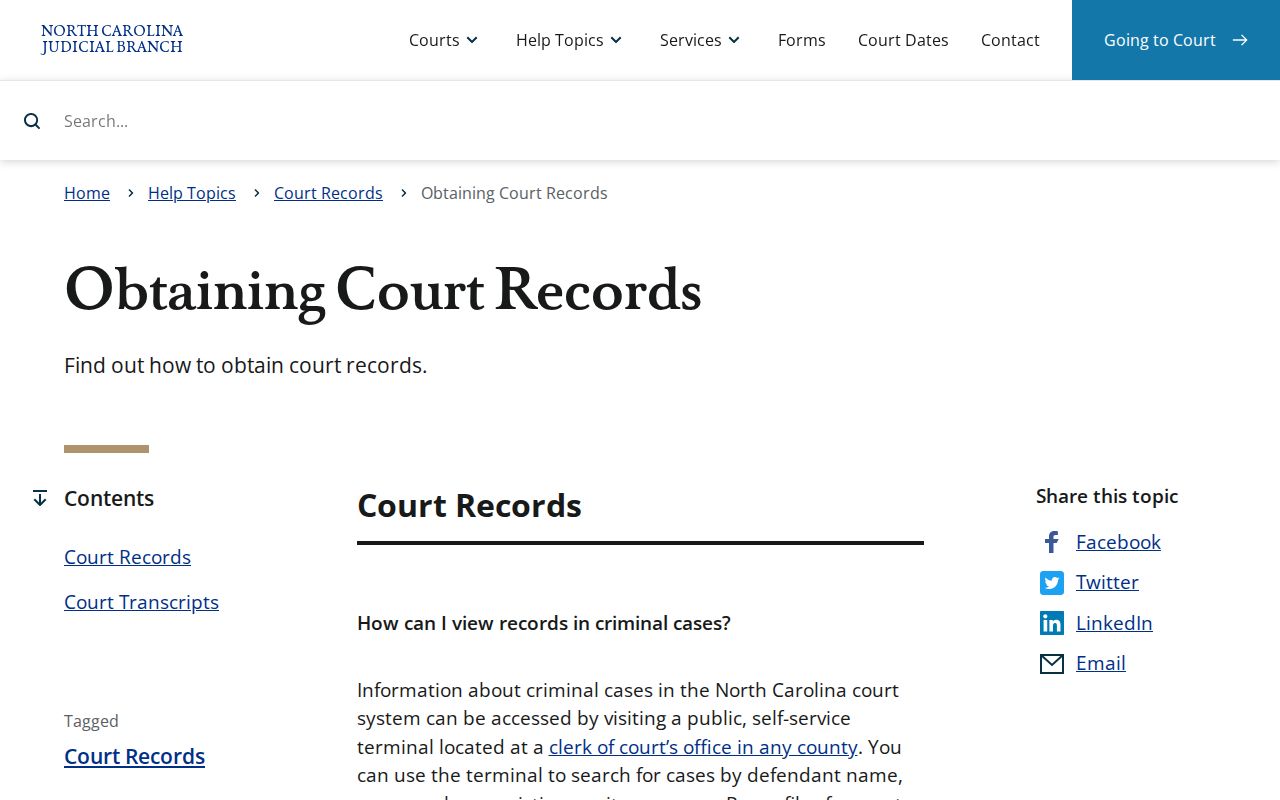
The clerk route is the right fallback when a screen summary cannot establish the contents or certified status of a Clay County case file.
How a Criminal Case Moves
North Carolina's official criminal-case outline begins with an alleged offense and continued investigation. Arrest or a charge may follow, along with bond and a first appearance. A felony can proceed through a probable-cause hearing and grand-jury indictment. The person may enter a plea or go to trial. If guilt is found, the court enters sentence. An appeal can add a later stage and sometimes a linked file.
Clay County case flow: Charges Filed › Arraignment › Pretrial › Plea or Trial › Disposition › Sentencing
Those steps do not all occur in every case. A charge may be dismissed early. A plea can avoid trial. A misdemeanor appeal may shift the record from District Court to Superior Court. Use each dated event, not a single status label, to place the Clay County matter in its true stage.
Reading Clay County Case Outcomes
Disposition language must be read one charge at a time. A case with several counts may end in more than one way. A booking allegation may also differ from the prosecutor's filed count, so do not force the arrest label and court result to match word for word. The Clay County arrest lookup explains the separate arrest and booking trail.
- Dismissed
- The prosecution ended that charge without a conviction; the earlier arrest record may still exist.
- Not guilty
- The court or jury acquitted the person on that charge.
- Guilty or convicted
- A plea or verdict produced an adjudication of guilt.
- Pending
- No final disposition has yet been entered in the displayed record.
- Prayer for Judgment Continued
- A distinct North Carolina outcome that should not be reduced to the word dismissed.
Deferred prosecution, conditional discharge, and diversion also have distinct effects. North Carolina's structured-sentencing statute shows why a felony class alone does not establish the sentence. If the Portal wording remains unclear, obtain the judgment or final order from the Clay County clerk rather than guessing from a brief status line.
Clay County Court Case Payments
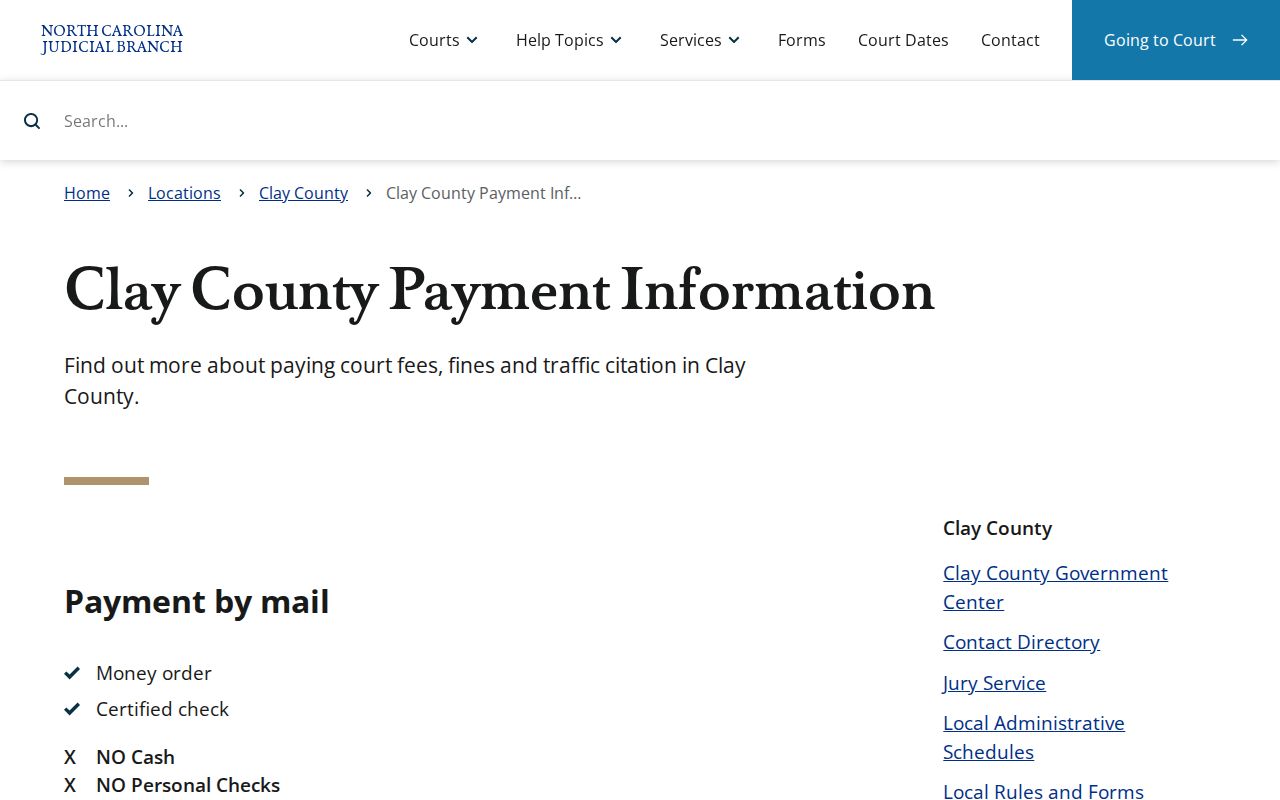
Clay County's official payment page separates mail, counter, and eligible online methods. Mail payments may be a money order or certified check, payable to Clay County Clerk of Superior Court. Cash and personal checks are not accepted by mail. Include the citation number when it applies. At the counter, cash, money order, certified check, and major credit or debit cards are accepted, subject to card processing fees and restrictions. Eligible online obligations also accept major cards with processing fees.
The Clay County payment page is the current official source. Its captured screen helps distinguish payment options from the case-search function.
Recheck Smart Search before paying because a balance shown in one Portal block may not explain the full Clay County judgment.
Case Record Access & Restrictions
G.S. 7A-109 court-record access works through the clerk, but access is not absolute. Sealed cases, confidential juvenile matters, protected victim information, and documents restricted by another law or court order remain outside ordinary public view. G.S. 132-1.4 treats active investigative material differently from filed court records. Returned arrest and search warrants, indictments, criminal summonses, and certain identification orders are public court records unless sealed.
When a public Clay County case exists but a document is absent online, ask whether it is available in the clerk file, confidential, sealed, or simply not displayed as a Portal image. Request a redacted copy of any separable public portion when a record contains protected material. Clerk staff can explain access steps but cannot give legal advice or interpret an outcome for the reader.
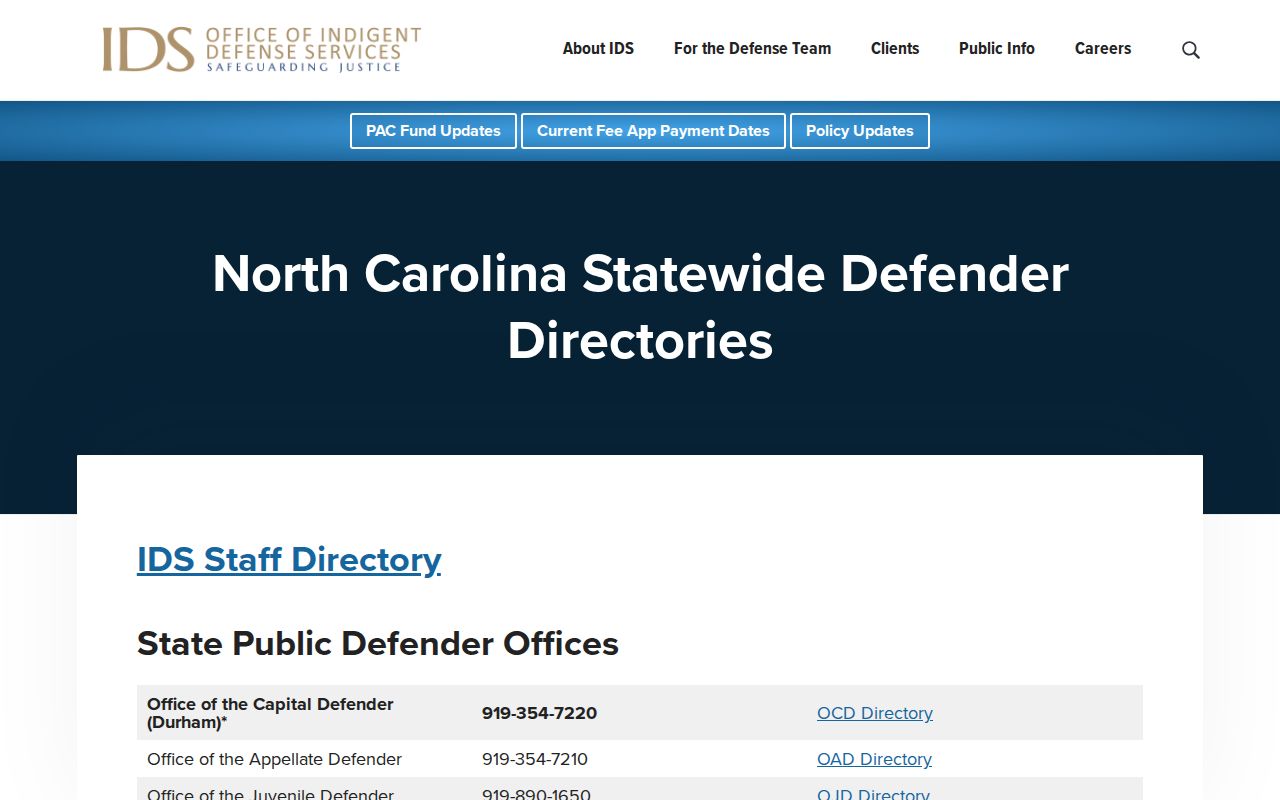
The North Carolina defender directory provides the official route to indigent-defense office contacts. The captured directory is a contact aid, not part of the Clay County docket.
Verify any legal deadline or case consequence with the court record and qualified counsel.